The Word "Emoji" Is Older Than You May Think
We've spent a lot of time on this blog correcting the record on when the first emoji set was launched. Now there's a new thread to pull, and it isn't just another device from another manufacturer with another "proto-emoji" set: this 1988 manual explicitly refers to its icon set as emoji.

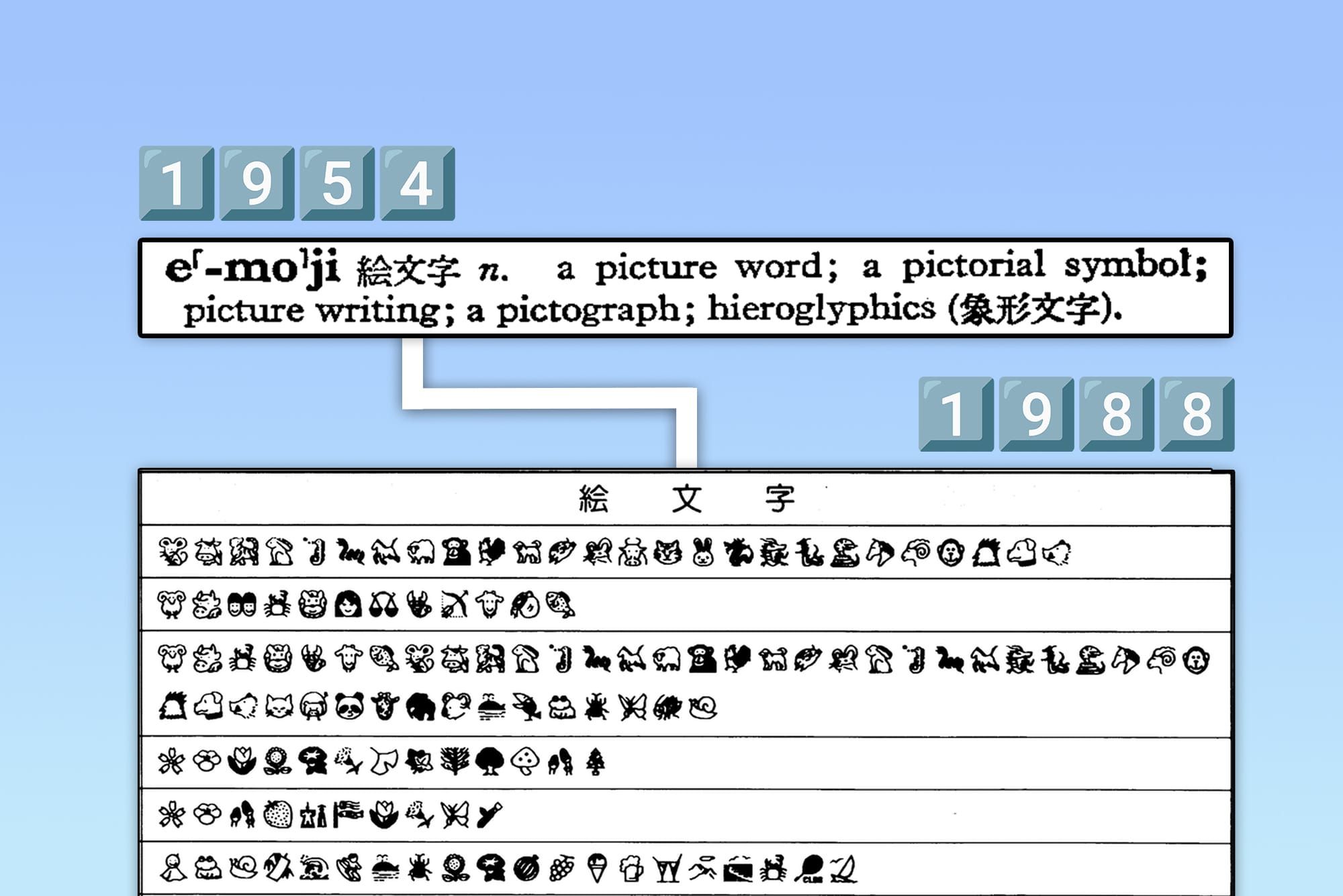
We've spent a lot of time on this blog correcting the record on when the first emoji set actually shipped, and reporting on newly uncovered "proto-emoji" sets from Sharp and NEC devices that predate mobile phones entirely. Now there's a new thread to pull, and it isn't just another device from another manufacturer with another "proto-emoji" set: this 1988 word processor manual explicitly refers to its icon set as emoji (絵文字).
Researcher and game designer Matt Sephton, who has spent months tracking down vintage Japanese electronics with emoji-like symbol sets built in, made this discovery when a friend shared with him the manual for a 1988 Toshiba Rupo JW95F word processor.
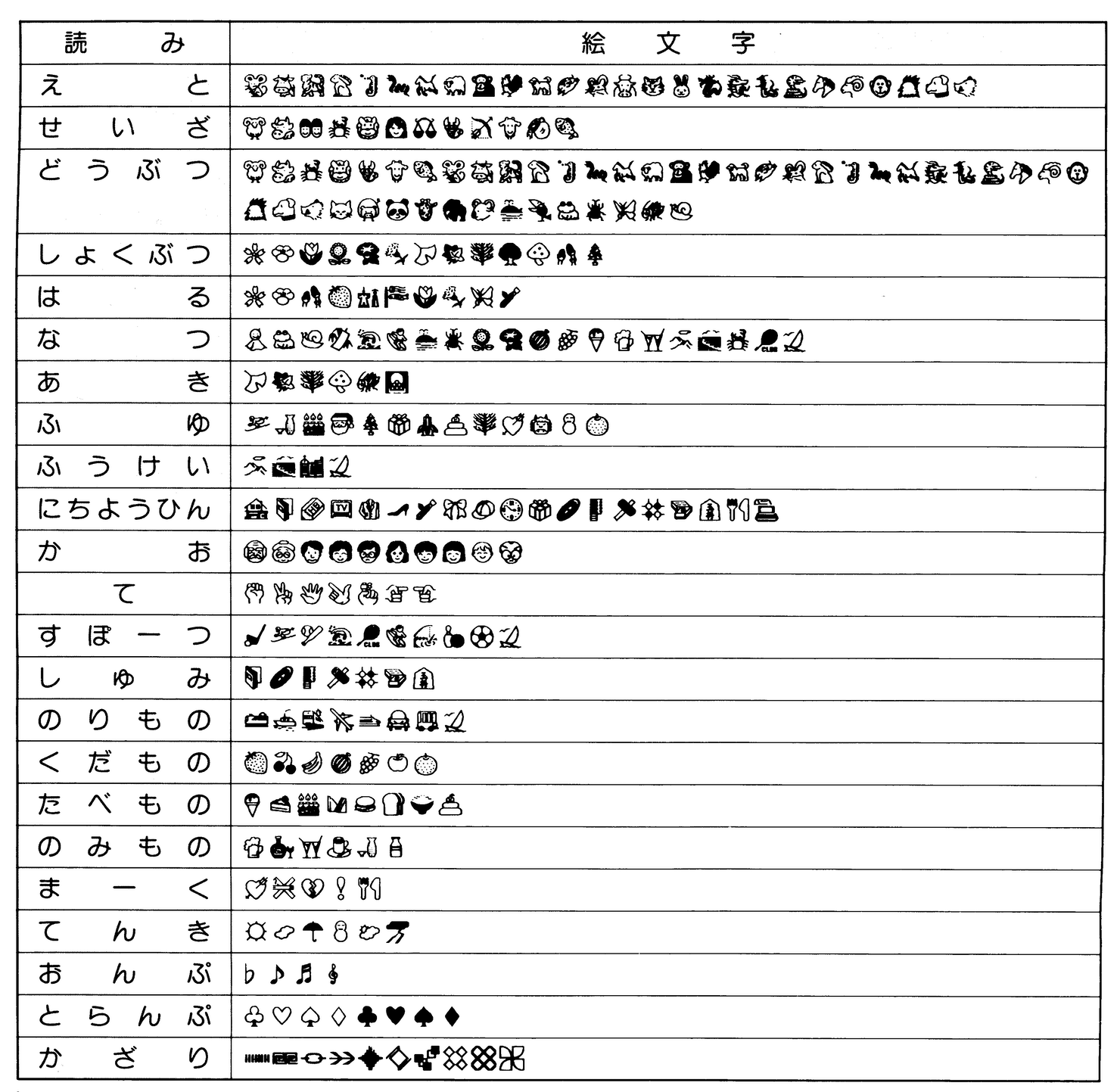
There it is: concise and plain, the term 絵文字 (e-moji), "picture" (絵) plus "character" (文字), appearing as the column heading for the device's selectable pictographic characters.
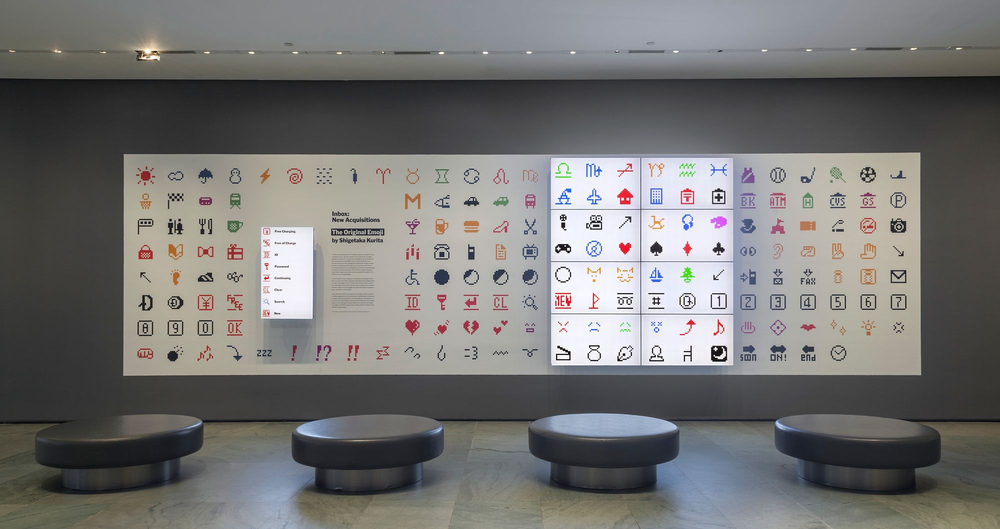
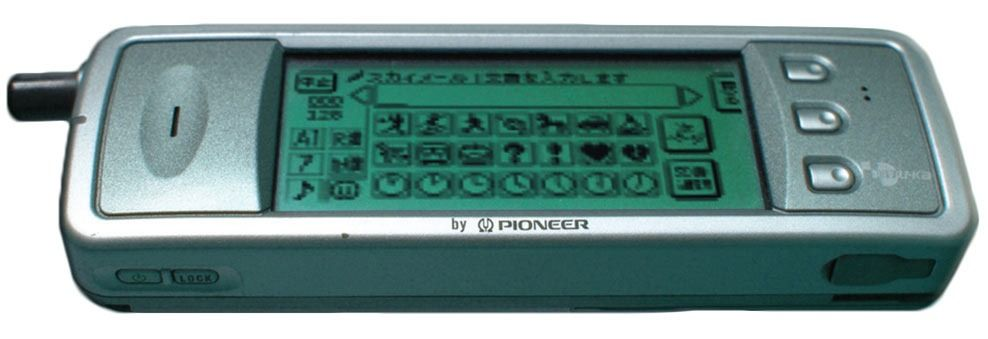
That's older than the oft-cited Kurita/DoCoMo i-mode set from 1999, and older than SoftBank's 1997 Skywalker phone too, the device where, as it happens, the word shows up in exactly the same way, labelling exactly the same kind of thing.
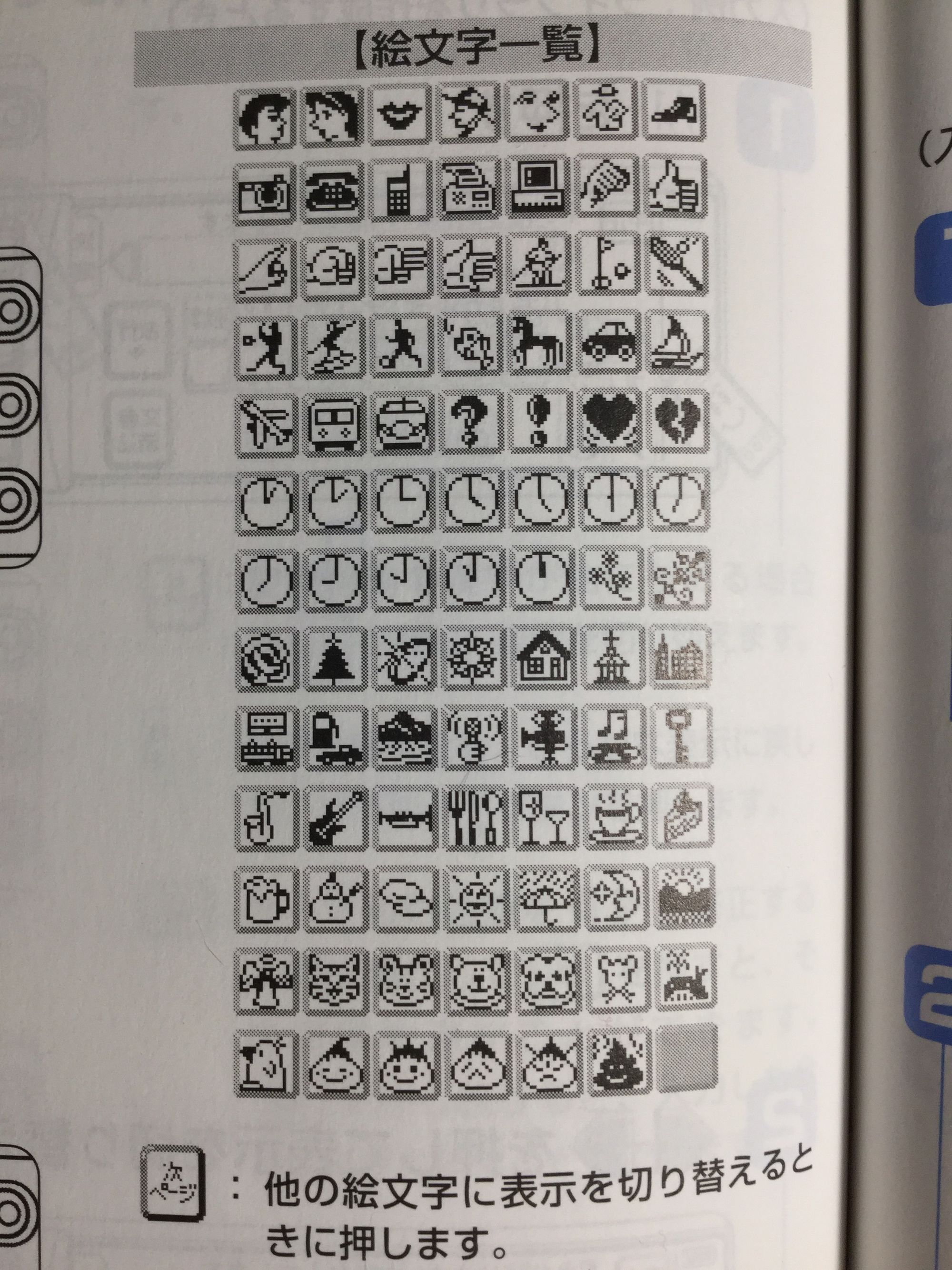
But this isn't actually the earliest known instance of 絵文字 being used at all, just the earliest we've found where it's being used quite this specifically and intentionally, to name a discrete, selectable set of digital characters designed to be inserted into text. The word itself is actually far, far older than you may think, and it predates the creation of consumer technology as we know it.
An important note before we continue, however: all credit for surfacing many of these discoveries belongs to Sephton. They are the product of his working through vintage manuals, catalogues, and archived Japanese print. We're writing this piece for the Emojipedia blog to put a wider spotlight on that research, because it's exactly the kind of primary-source work that tends to get buried under the much simpler, much more repeatable "Kurita invented emoji in 1999" story.
Emoji Isn't A Digital Word
While chasing down the Toshiba manual, Sephton made what he describes on his own blog as a side discovery: the word 絵文字 itself has a far longer paper trail than the device history alone would suggest. His earliest confirmed citation is a dictionary headword, Kenkyūsha's New Japanese-English Dictionary, 1954, which he calls the standard postwar bilingual reference of its day.

That's a settled dictionary entry, 45 years before DoCoMo's i-mode set. Sephton makes a nice observation about the ordering, too: "pictorial symbol" is listed ahead of "hieroglyphics," and by lexicographers' convention, that's the more central, more everyday sense of the two.
1954 isn't even the beginning. The Oxford English Dictionary's own etymology entry for "emoji" states that the Japanese term is attested from 1928 or earlier, and suggests it may originally have been a loan-translation, a calque, of the English word "pictograph."
That earlier date comes with less paper trail attached: unlike the OED's precise citation for the word's English debut (the Nikkei Weekly, 27 October 1997, in a piece about P-kies CD-ROM Emoji Word Processor software), the 1928 date carries no publication, no page number.
A real and citable claim from a serious dictionary, but an unsourced one. That's exactly the kind of gap Sephton's research fills: he's the one who's gone and found the word actually being used, in print, again and again, across the decades the OED's etymology leaves undocumented.
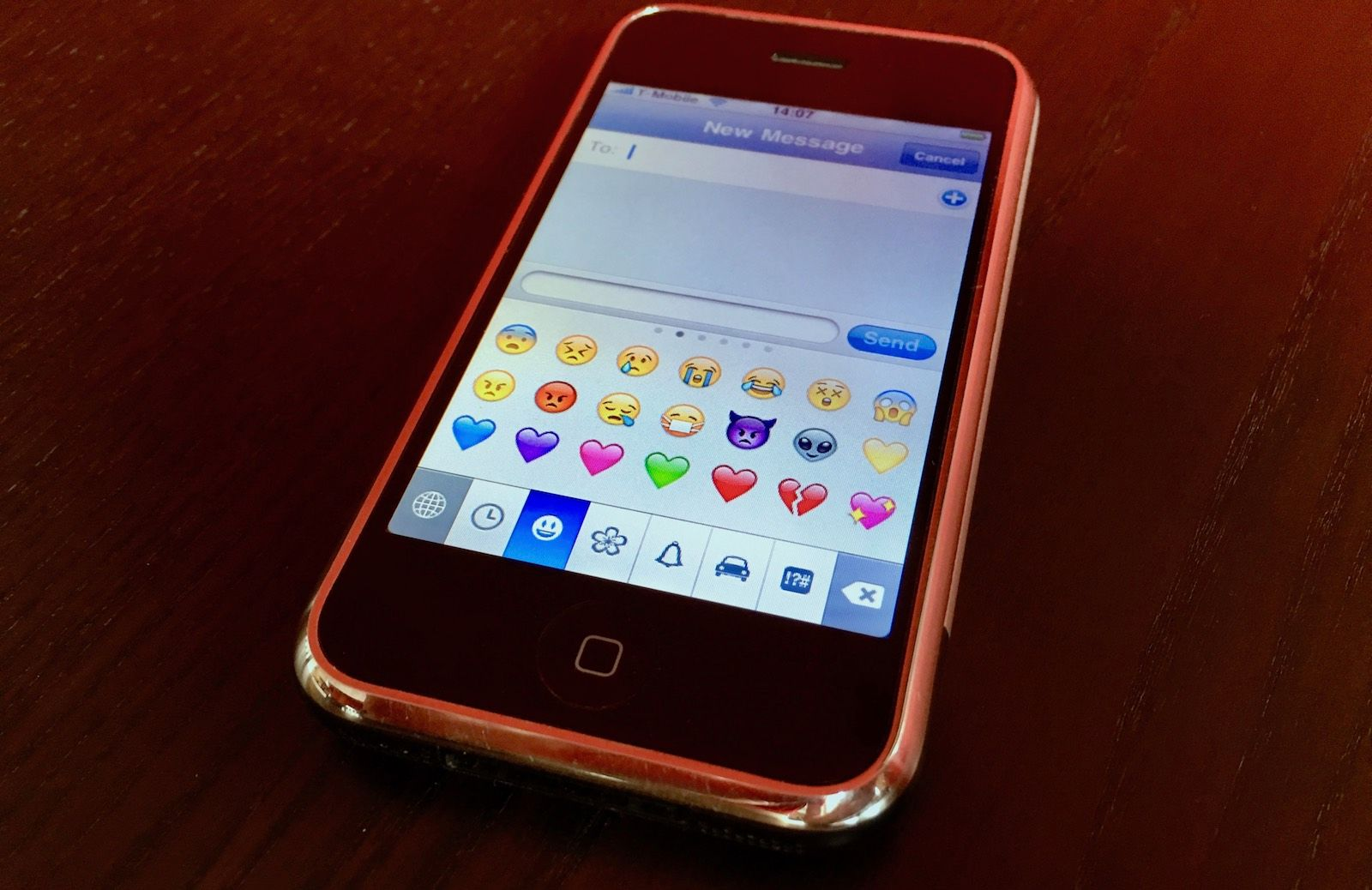
The Japanese word would of course later begin a second life in English and other global languages. It stayed a niche term even after the Nikkei Weekly citation, reaching a Western mainstream outlet for the first time only in October 2001, when Wired described tiny pixelated images standing in for words in mobile messaging, and it remained obscure outside Japan until Apple's emoji keyboard went international in the early 2010s.
What all of this establishes, between the OED's etymology and Sephton's dictionary find, is that the word's Japanese life stretches back to at least the 1950s and quite possibly decades earlier: long before there was any digital text, or any digital shorthand for emotion, to insert it into.
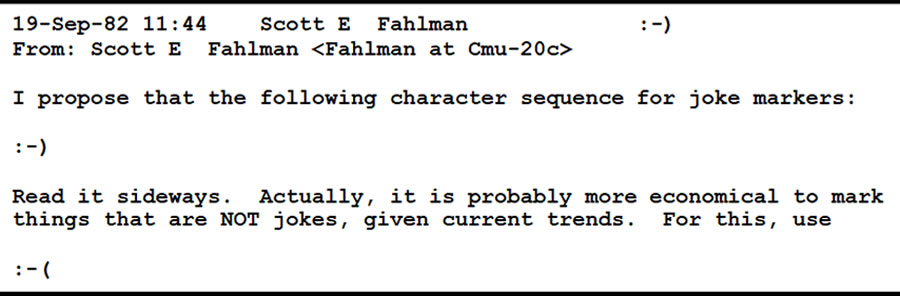
Unlike emoji, both emoticon (coined by Carnegie Mellon's Scott Fahlman in 1982) and kaomoji (posted by designer Yasushi Wakabayashi in Japan in 1986) were purpose-built for a specific digital problem: representing emotion in text. 絵文字 never was. Emojipedia has written elsewhere about how those terms jostled for territory once digital communication actually needed them, where you can read about the fuller picture.
"Emoji" As Icons In An Increasingly Digital World
Beyond the 1954 dictionary entry, here's the rest of the paper trail Sephton has assembled, almost entirely outside the English-language record:
- 1975: A Sony catalogue describes the panel of its ETV-4010 school AV mixer as carrying colour-coded 絵文字, referring to small pictographic control labels.
- 1984: Designer Kuwayama Yasaburō published a 431-page reference book titled 世界の絵文字 ("Emoji of the World"), cataloguing global logos, pictograms, and trademark design from the 1970s and early '80s.
- 1984: ASCII magazine's review of the Canon PW-10 word processor notes that assorted symbols and 絵文字 could be called up at the touch of a button.
- 1985: A pocket dictionary supplement distributed by MSX Magazine through Japan National Railways station kiosks uses 絵文字 as the umbrella term for icon-like symbols, and complains that the imported English word "icon" (アイコン) was starting to encroach on territory 絵文字 already covered.
- 1993: Researcher Nojima Hisao published "絵文字の心理的効果" ("Psychological Effects of Emoji") in the Japanese intellectual monthly 現代のエスプリ, cited the following year in Pacific Telecommunications Council proceedings in Honolulu.
Why This Toshiba Discovery Matters
Almost every citation above uses 絵文字 in a fairly broad sense, closer to how English speakers might casually say "icon" or "symbol" to cover almost any small pictorial mark, whether it's on a mixing desk, in a design annual, or standing in for "pictograph" generally.
That breadth lines up with the OED's own etymology, and it's not quite the same thing as emoji in the sense we mean today: a defined set of small pictorial characters, designed to be typed or inserted inline with text.
That's what makes the Toshiba manual, from the very top of this piece, stand apart from the rest of Sephton's trail. It isn't glossing or explaining the word, it's simply using it, as a plain column header, to label a table of characters a user could select and insert directly into a document, sitting alongside kanji and kana input tables.
(There's also a seahorse in that character set, incidentally, which is something we'll cover more explicitly tomorrow on World Emoji Day itself.)
By 1988, at least in the word-processor and electronic-organiser world, 絵文字 had already narrowed from "pictorial symbol in general" to something much closer to what we'd now recognise as emoji.
That's the same kind of specificity we can see nine years later in SoftBank's own Skywalker manual, which lists its 90 characters under exactly this kind of explicit, deliberate heading: a discrete, named set, not a loose descriptive term.
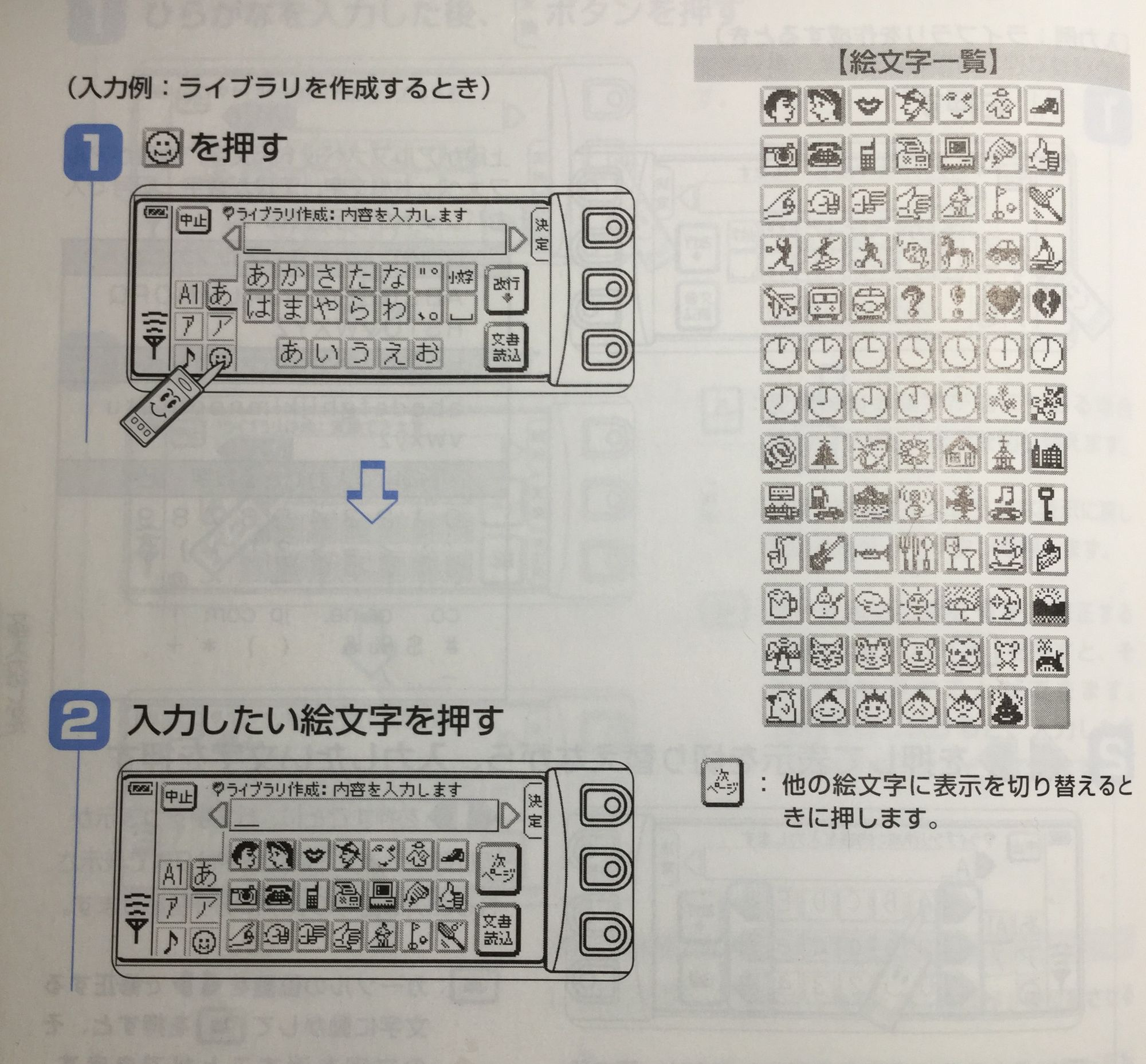
That specific framing is, in part, why the Skywalker set has historically been treated as a dividing line: everything before it tends to get filed under "proto-emoji," while the Skywalker set itself gets called the first "real" emoji set.

That distinction is, admittedly, somewhat arbitrary; the Toshiba manual shows the same specific usage nearly a decade earlier, just on a word processor rather than a phone.
Skywalker still retains one meaningful distinction of its own: it was a mobile device capable of sending and receiving messages, a genuine threshold even if the line itself was drawn by hand rather than found in nature.
Drawing that kind of line by hand is nothing new for this blog. SoftBank's own claim to the first emoji set only entered the record in 2019, after years of independent digging by researchers including Mariko Kosaka and Matt Alt, credited in full in our own correcting the record piece. This latest discovery is cut from the same cloth: buried research, rediscovered.
Closing With The Usual Caveat
We'd be doing the work of Sephton and other researchers a disservice if we presented this as the final answer.
This particular discovery we're highlighting today is thanks to the dedicated efforts of one researcher and his friends, working through a limited set of manuals, catalogues, and magazines that happened to survive and happened to be findable, and Japanese trade literature from this period is vast, unevenly archived, and mostly untranslated.
So there's almost certainly much more still to find.
Rather than revealing a single moment when emoji were "invented," discoveries like this suggest a much slower evolution, one in which the word, the idea, and eventually the digital characters themselves all emerged over decades. Every newly uncovered manual doesn't close the story. It makes it richer.